

make suffering your bridge instead of your cage
or how to be in each other's metaphorical holes

“You go through life for a long time thinking, ‘no one has ever suffered the way I’ve suffered, my God, my God.’ And then you realize…You read something or you hear something, and you realize that your suffering does not isolate you; your suffering is your bridge. Many people have suffered before you, many people are suffering around you and always will, and all you can do is bring, hopefully, a little light into that suffering. Enough light so that the person who is suffering can begin to comprehend his suffering and begin to live with it and begin to change it, change the situation. We don’t change anything; all we can do is invest people with the morale to change it for themselves.”
- James Baldwin (interview circa 1971)
This quote makes me pause and take a sigh of relief each time I hear or read it. It touches on the deeply human desire to be seen and the simultaneous shame we feel when we feel no one else really sees us, that our suffering is somehow so unique that it stigmatizes us. I believe in Baldwin’s insistence that being human is a constant exercise in resilience, an ongoing practice in facing the impossible, and using suffering as an opportunity for connection. When we romanticize our suffering instead of using it as a tool for development, our suffering is not a bridge, it’s a cage. Our suffering is unchangeable, but the way we choose to suffer isn’t.
What does it mean to romanticize your suffering?
Romanticizing our suffering is one way I think we rob ourselves of the aforementioned benefits of suffering. What do I mean by this? I mean that some of us resign ourselves to suffering. Not only do we accept it, but instead of using it to parse out our own wounds and barriers to flourishing, we identify with our suffering.
Romanticizing your suffering may mean you shroud it in some kind of aesthetic or water it down to a personality trait. I have been guilty of identifying with my suffering at times. You’re talking to a girl who’s top artist was Mitski two years in a row and was in the top 0.5% of listeners. I was betting on losing dogs, glowing pink in the night, etc etc. I love Mitski and sad girl music to this day, but I also go out of my way to curate joy and whimsy in my life. That’s what I want to identify with. Not the girl who walks around with a black cloud above her head, raining on everyone’s parade and sucking the energy out of a room with my misery. I am much more than my fears and insecurities, and so are you.
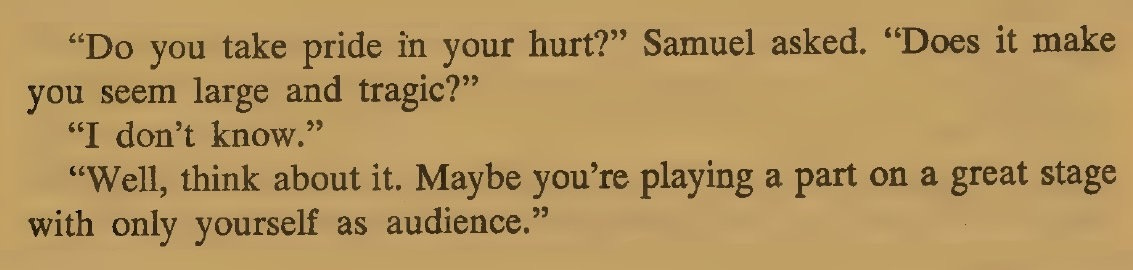
Like many things in life—our careers, our genders, our styles— we individualize our suffering, nurturing it and developing it until we are subsumed by it. It becomes a personality trait, a way to make it mean something more. We’ve learned to make suffering a part of our selves. You are no longer just a human being that suffers; you are a sufferer. This is one way to think about what it means when your suffering becomes your cage instead of your bridge.
I think the most dangerous part of romanticizing your suffering outside of it’s inherent deceptiveness is its ability to trap and isolate you in your misery. We aren’t meant to suffer alone. I believe religion is perfect evidence for this. We ultimately crave a way to assign meaning to the suffering life causes. Although I have never been religious I understand the value of religion because religion ultimately offers a way to bridge people in their suffering. Whether you practice a religion actively or you use it as an internal compass, these are the worldviews that connect us with other people, and the ideas that can help us make sense of and hopefully overcome the hardships that inevitably come along with being alive.
As long as I can remember, my grandma has always practiced Nichiren Buddhism, and she continues to make every concerted effort to get her grandchildren to chant with her or sends pictures of motivational quotes from her readings to our family groupchat. While the rest of us are not zealous practicers, it is easy to appreciate the core messages. I’ve always resonated with Buddhism as a life philosophy or worldview because of its simple yet liberating perspective on suffering. Accepting that suffering is a part of life is not damning when you realize that suffering is the source from which we can experience all the most beautiful parts of life. We draw the strength of resilience, find points of connection, and gain clarity of our values from the moments that remind us how much life can take from us when we aren’t looking.
Buddhism teaches us that the root of suffering is clinging to pain and loss rather than letting it teach us. Despite the many challenges and painful experiences my grandma has faced in her life, I see how her commitment to her principles allows her to always lead with love and positivity. I remember moments as a child when I would be so upset about whatever it was I got upset about back then, and I never saw her get upset. In fact, her calmness in my times of crisis made me feel embarrassed because maybe it really wasn’t that serious and maybe it really was going to be okay just like she said. Her unwavering warmth and resolve always puzzled me and also made me envious of her. To this day, she moves through life with a levity that is so comforting to me, and she is the perfect example of how not to romanticize your suffering.
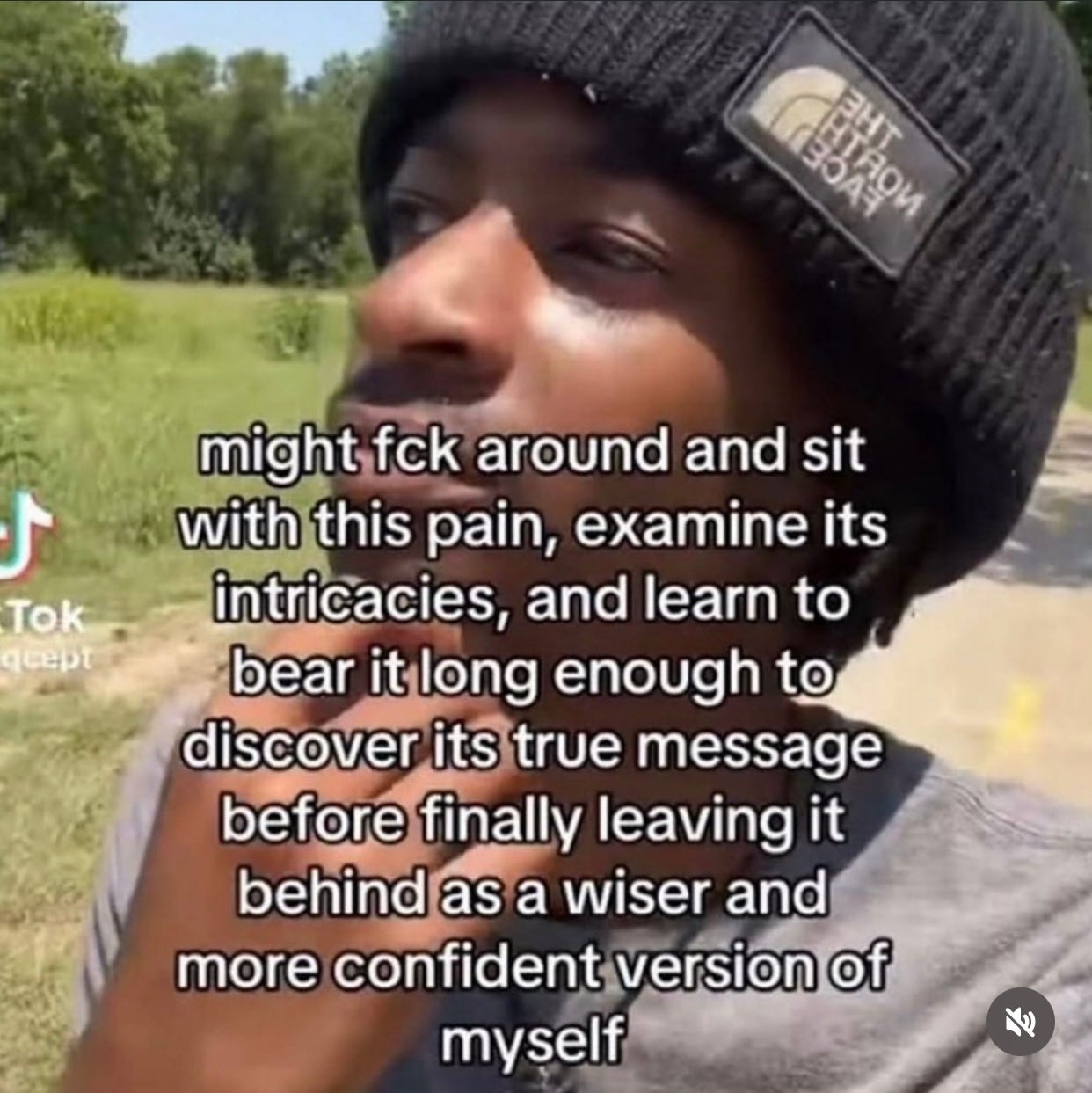
I say all this to say that suffering exists whether we like it to or not, yet there are so many ways we relate ourselves to our own suffering—some helpful and some not so much.
How to make suffering your bridge instead of your cage
Unpack your suffering with others.
Being vulnerable means allowing suffering to be seen. I’ve said it before and I’ll say it again: healing does not happen in isolation. It can only happen through caring for other people and letting people care for you. What we all ultimately crave is connection, yet when we romanticize our suffering and let that be a barrier rather than a bridge, we are signaling to everyone else that no one else could “get” us, so why should they even try?
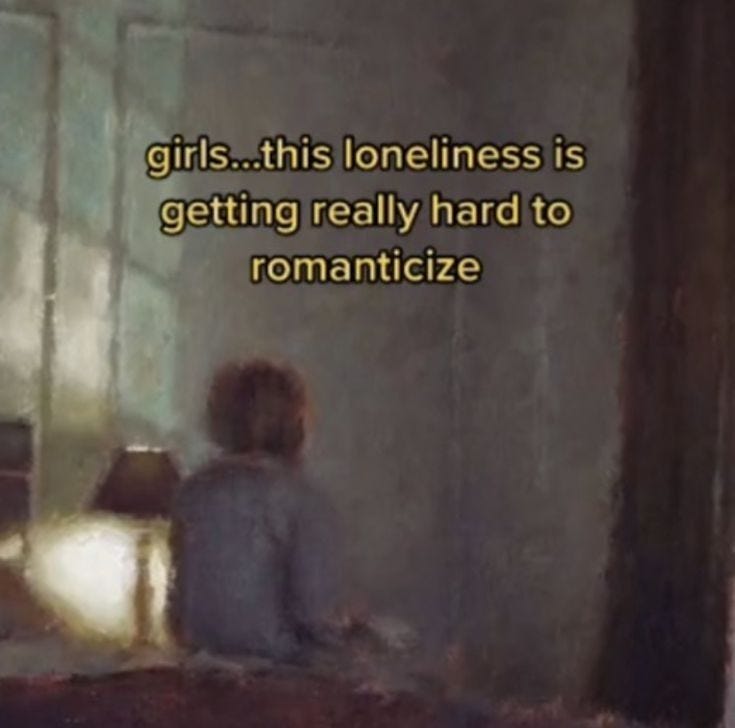
I think about people who romanticize their suffering as being stuck in their teenage years…Think about how we all felt in middle school. No one understands us. Everyone else is the problem. If only they could just stop being so annoying. Life is so unfair wahhhhhhh…. And you know what? Valid. We all deserve to crash out in our teenage years, but externalizing your problems to the point you are blind to your role in your suffering means you’ll never escape it. For those who never outgrew their teenage angst, your obsession with being different is keeping you from connecting. Rather than stomping inside and locking yourself in your (real or metaphorical) room with the music too loud to hear anyone, keep the door open, blast the sad music, then wait and see who comes to sit with you. Let yourself be seen and understood.
I call this “being in the hole” with someone. My friends and I discovered this idea after reading Cleopatra and Frankenstein by Coco Mellors for book club. We all discussed our admiration for this particular part in the story. In one scene, one of the protagonists receives surprisingly poignant advice at a sex meditation group which leads to revelations about her own life and relationships. In the book, the man leading the session tries to explain the purpose of the sessions to Cleo and her partner’s half-sister/kind of friend Zoe:
“One day, out of the blue, a guy falls into a deep hole. Help, help! He yells but no one comes. Eventually a rabbi walks by. He lowers a Torah down and tells him to pray to find a way out.
“Next, a priest walks past and gives him a Bible. Again, no result. A psychiatrist tells him he’s stuck because he’s depressed and throws down some pills. No dice. A nihilist tells him to imagine the hole doesn’t exist but that doesn’t work either. A politician, an intellectual and a bunch of others try but nothing works. Then a spiritualist, a wise man really, comes to the edge of the hole. He looks down at the man at the bottom and jumps right in with him. And that’s what this meditation is about, Zoe, someone getting in the hole with you.”
So you see, the point is not to kill yourself trying to solve your problems alone, but to let people in, to make your suffering a point of shared experience and collective problem solving rather than searching desperately for cheap, quick ways to get rid of it. And, sometimes there is no problem solving to be done. Sometimes you just need to someone who will sit with you and recognize that yeah sometimes life sucks or its monotonous or just exhausting, but what a gift it is to experience it with other people living for the first time too. Now, me and my friends make a concerted effort to be in each other’s holes.
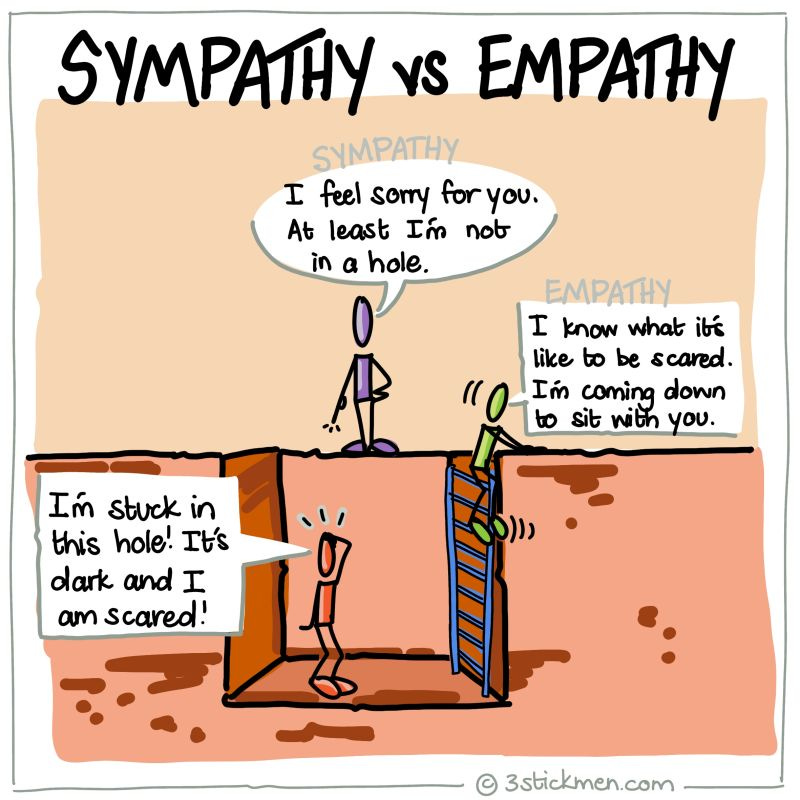
I find Brene Brown’s explanation of empathy to be especially useful when thinking about what this looks like in action. It requires at least four things—taking on the other person’s perspective as their truth, refraining from judgement, recognizing emotions that you may have felt before in other people, and communicating your recognition of their emotion(s). Being in the hole with someone is feeling with someone.
The key part of this metaphor is the mutuality of it. I think it’s important that what you see as vulnerability isn’t trauma-dumping but reciprocal support. Like any collective project, you must give and take. You must collaborate towards shared understanding rather than simply cope in mutual misery. (My friend Zoe who I often get in the hole with wrote a great article on recognizing the time and place for vulnerability and how to do it without drowning in it.) Ensure that when you let someone in your hole, you’re sitting in theirs too. Look at each other, really see each other, but remember to look up at the sun every once in awhile too.
Identify with things other than suffering.
Engage with people and opportunities that contradict your negative narratives. Be curious about the world. Be curious about other people and let them be curious about you. Humble yourself by recognizing the complex inner lives of everyone else around you. Turns out we all suffer in similar and different ways, but surely there is a reason we all continue on? Whether we are suffering as a collective under the material and ideological effects of capitalism or suffering at the most individual, emotional level, I think Margaret Thatcher’s famous political insistence that “There is no alternative” is the same extremely limiting belief that allows us to remain deeply entrenched in our suffering. There are alternatives to your suffering.
One problem with romanticizing your suffering is that you offer yourself no alternatives. You are attached to an identity based in your suffering. Identity is important, and attachment is inevitable, but if you’re going to attach your sense of self to anything, do it to things and people that inspire you at least. Maybe you start learning sad songs on guitar to cope with your breakup, but eventually this turns into a cathartic past time that brings you joy. Maybe you reach out to that friend you’ve ignored for too long because you thought you were too miserable to socialize, and you go out and make a concerted effort to be in their world instead of your own for awhile only to find you are having a lovely time. Maybe you write Substack articles to help you make sense of yourself and your false catastrophizations and find that other people are writing about all the same things too, and even though you worry you’ve never had an original thought in your life, you feel a lot more normal now that you’ve taken a moment to pay attention to what other people are going through. In short, do things that are good for you, even if (especially if) they are things that seem difficult.
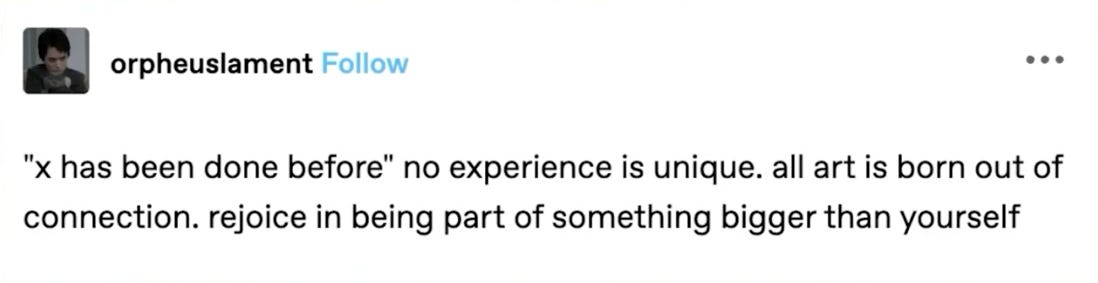
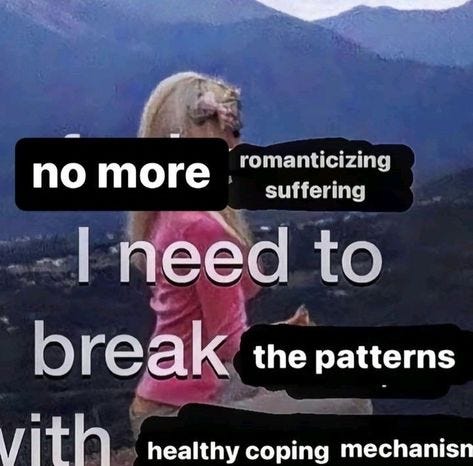
And if you decide you are a sufferer and can’t identify with better things, you will simply become extremely unpleasant to be around. Suffering makes you insufferable. I say this not to sound cruel, but because not only is your suffering the shroud of quills you wear that keeps everyone at arms distance—what is cruel is treating yourself this way. Your self-limiting belief system is to your detriment. It is a self-fulfilling prophecy. You are miserable because you’re suffering, and you’re suffering because you’re miserable. You should get to know yourself outside what makes you hate yourself or what makes you afraid. It’s okay to have the thought sometimes that maybe you’re not good enough, maybe you’re not capable, maybe you’ll fail. This is what makes you human. We can only know ourselves through the ways we confront these thoughts and through continuous attempts at living in spite of them.
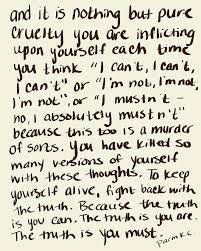
Make discovering yourself an active practice in exploring alternative narratives and outcomes for your life. Dream up the person you want to be and let that be a guidebook for your life instead of a fantasy. I don’t say this like it’s super simple, but it’s also not as impossible as we make it seem. Don’t ignore the painful beliefs that echo in you, but find acts of resistance to them. Investigate and debunk them. I know its hard to ask for help, but do it. Ask a friend for words of affirmation. If you feel useless, put yourself in situations where you can prove to yourself that you’re not. If you’re an overthinker and this is debilitating to your daily life, ask your therapist for help disentangling reality from your cognitive distortions. Let your partner talk you through a situation until it feels less impossible to navigate. Let the world teach you by allowing yourself to be uncomfortable over and over until you feel lighter. Be kinder to yourself. If not for yourself than at least do it for the other people in your life who would love to see you try.
Do not accept defeat.
Stop agonizing over yourself. You are stuck with yourself, so you might as well get to know you and figure out how to deal with yourself. I don’t mean read self-help books and chase self-improvement in a rushed and panicked state either. If you are deeply in love with your suffering, it will take a laborious journey to break up with it, but with the right mindset and right approach, it is more than possible. Take it from me. You can’t hate yourself into being a better person. You can only do that through love.
As someone who has spent years in therapy, unlearning some negative thought patterns, I feel it is easier for me to recognize the same in others now. I think of an example of a guy I once spent maybe a maximum of three days talking to from a dating app. He enjoyed our messages so much that he eventually insisted we message via Discord because it was what he liked to use and where he spent a lot of time because he was always on his computer for his remote work and video gaming. However, when I voiced that I prefer to meet in person rather than begin dating virtually, he seemed uncomfortable with the idea. He said he wasn’t ready to go on dates or meet in person because he was “just an introvert” and felt an in person date was moving too fast. I found that strange for someone who was looking for a relationship. We were having first or second date types of conversations over Discord (like what?), and his insecurities were on full display. When I asked more about his work and aspirations, he said he wanted to be a video game designer, but he had zero plans to get there nor was he actively working toward it in any way. When I asked about hobbies, he had none (unless you count working out in his room and gaming.) His only activities outside of work were done from the comfort of his room, and his excuse for not being in the job he desired or living a more “extroverted” life style is that it was just who he was. Here seemed a perfectly nice, attractive, normal guy who held decent conversation who just seemed to be dissatisfied with his life and really with himself. Where I saw potential to be so much more if he could just go out of his comfort zone (or even just leave the house like ever), he saw a failed video game designer, an introverted, socially awkward guy struggling to date.
If he could only escape his self-imposed suffering, he could live out his values and aspirations even if in small but meaningful ways. Complaints of a loneliness epidemic and lamentations of the impossibility of dating on apps are surely valid, but there is also so much of these issues that come from a lack of self-love based in self-discipline. Accepting this victim mentality takes away agency from yourself to change. This idea that things are always happening to me instead of because of choices you make absolves you of confronting the things you could be doing (or things you should stop doing) to live a more fulfilling life. When you resign yourself to a lackluster life, you become more comfortable sitting in your suffering than you are with growing and curating your inner world.
I don’t mean to make the argument that everything is a puzzle to be solved, but a lot of things are. As Mina Le offers in her Cheat Sheet:
“The point is to feel like an active participant in your life, to feel that your bad choices can be changed or that your bad choices are indeed your choices. Maybe it’s a cope to reframe in this way. I definitely think corporations and corrupt governments are still responsible for many problems and we shouldn’t alleviate them from anything, but reminding myself of the control I do have over my life has made me a less anxious person overall.”
You have a lot of control over yourself, and it seems to me pretty nonsensical to ignore your capacity to grow and shape yourself into the person you want to be if that is an option. Like, it is literally possible to change aspects of your personality if thats what you want. Ironically, the one constant thing in this world is change, yet it seems to be human nature to fear it. We are equipped for evolution and adaptation, yet so often we resist. Humans are much more pliant creatures than we give ourselves credit for. Think about the way you experience the world as malleable rather than static.
The psychological concepts of “state” versus “trait” comes to mind. As psychologists Chaplin & Goldberg (1988) describe them:
“Prototypical traits are stable, long-lasting, and internally caused. Prototypical states are temporary, brief, and caused by external circumstances…Trait concepts permit people to predict the present from the past; state concepts identify those behaviors that can be controlled by manipulating the situation.”
When you view emotions and experiences as states influenced largely by external factors rather than inherent traits, you recognize how much of your personality is shaped more by your socialization and environment than your biological or genetic makeup. It’s the old nature versus nurture argument.(Interrupting to once again plug the How We Feel app as a tool to track your emotions along with where you are, what you’re doing and who you’re with at the time you experience them to help you recognize that your emotional state is prone to changing and much of the time its heavily dependent on our immediate environment).
For my sociological minds, I am making a (hopefully more) nuanced rendition of the personal responsibility argument. In this case, it’s the dichotomy of structure versus agency. C. Wright Mills coined the term “sociological imagination” in The Promise (1959)to refer to viewing the individual in connection with larger society. It’s the idea that material or immaterial systems and institutions exercise great influence over our lives, but we also retain a sense of agency or free-will and the potential to self actualize as individuals. Either way you view it, what we know from the long discussions of both of these debates is that its never just one or the other. Each has its influence and its purpose. There are times when we are put out by structures or defeated by traits too difficult to shake, but most of the time, there are traits to be learned and unlearned and agency to be exercised. The point is we have constrained choices in this life, but we have choices. Put briefly, your suffering isn’t a personality trait, but at some point, your choice to stay in it might be.
Don’t get me wrong. Suffering is real. As a sociologist, most of the time maybe I put too much weight on the power of social structures on our lives, but it is undeniably true that more and more we live in a world where impersonal forces reign over our lives in ways we cannot possibly address at the individual level. As a result, we are all touched by systemic inequality and growing alienation in the realms of politics, gender, and even in our relationships to ourselves. Millions of people are living through atrocities most of us cannot imagine. There are many genuine instances of suffering, of course. I won’t go into all of those issues here, but I am pointing out the self-imposed kind of suffering. There is enough misery to go around without us creating new ways to be miserable. I think the most common way we do this is we presume suffering before it happens.
Are you suffering yet?
Stop waiting for the answer to this question. So much of our suffering happens in anticipation. How many times have we jumped ship on something or someone because of what could go wrong or because it felt unfamiliar? How many times have we anticipated change and associated that with something scary? How many times have we avoided vulnerability to avoid loss or clung to things only because it felt safe?
I am not saying suffering doesn’t exist. I am saying it does, and the purpose of life is to find ways to overcome it. Suffering cannot exist without its opposites. Love, happiness, relief, joy…the things we live for only matter because we have the capacity to suffer. There are so many ways to survive this life, and that is exciting and scary and difficult and beautiful all at once.
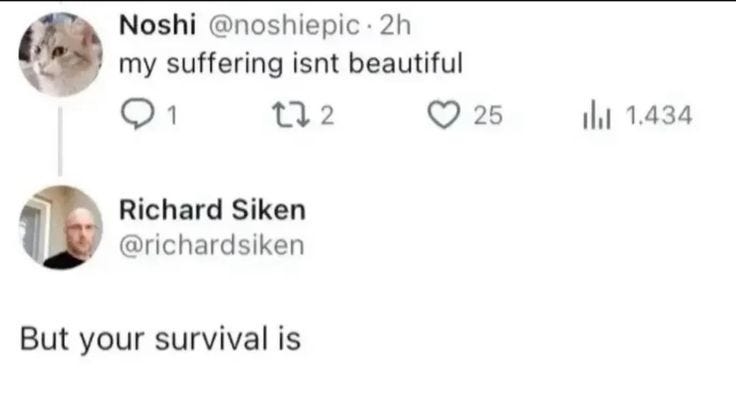
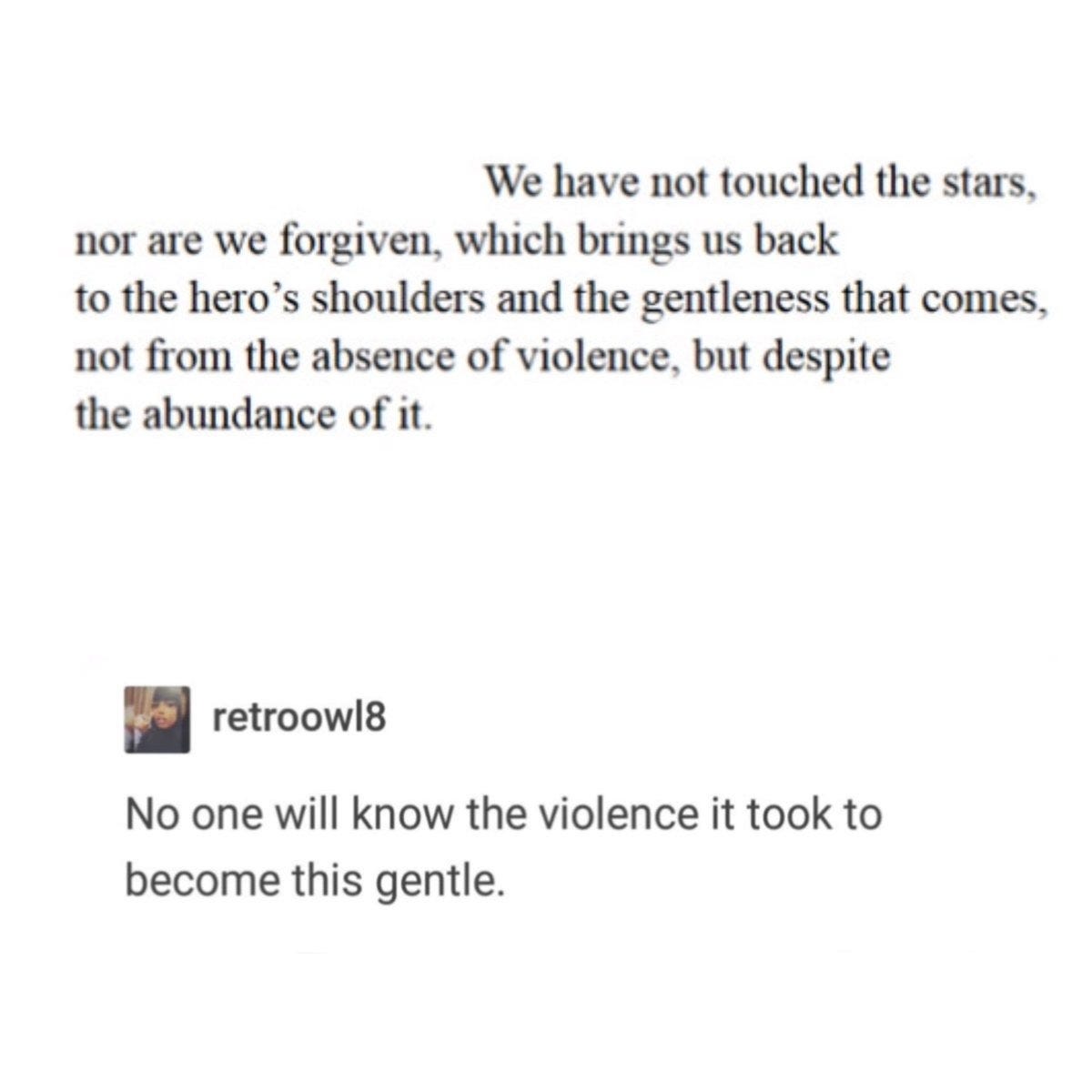
Stop borrowing grief from the future. Stop self-sabotaging before you even get the chance to lose something. Stop being too embarrassed to be brave. Take the fruits of life as they come, even the rotten ones, and cherish them while you can. Sometimes it will feel like mere surviving, but I believe with every survival you are get better at living.
A little something on the gift of writing that I think resonates here:

Loved this. Might be your best article yet!!
I really enjoyed this article! I'm a huge fan of quotes and I really enjoyed the East of Eden and Cleopatra & Frankenstein quotes. My friend and I were discussing loneliness and how our society's structure contributes to this. Thank you!